
iFood AI: behind the scenes of building the product
Building from the unknown
When Eric Ries wrote “The Lean Startup”, he taught us that “the only way to win is to learn faster than anyone else”. Our journey building iFood’s AI Assistant is the living embodiment of this principle. In a world where even Silicon Valley is still groping in the dark trying to understand how to integrate LLMs* into people’s daily lives, we decided to embrace uncertainty as our greatest ally.
*LLM large language model, it’s like talking to someone who has read practically the entire world library and can improvise new answers from that knowledge.
The Build-Measure-Learn Cycle at Maximum Speed
Our story began even before ChatGPT existed, we were like explorers in a completely closed forest. We started with a simple decision tree bot on WhatsApp, allowing orders at specific restaurants. It was our first hypothesis, our first MVP.
Result? We pivoted.
As Clayton Christensen describes in “The Innovator’s Dilemma”, truly disruptive technologies start simple, almost primitive. Our second experiment focused on basic recommendations for restaurants and dishes. AI was still crawling and the quality wasn’t where we wanted it.
Today, after less than 3 months of intensive development (really), we have an assistant that understands complex contexts through natural language. You can send a 5-minute audio telling about your tiring day, just type “Hi”, or describe in detail your dietary restrictions, and it will guide you naturally until you find exactly what you need, saving time and money.
And even after the pivots, we can still improve, and this is perfectly normal. Each day is a new iteration, a new learning, a new version better than the previous one.
About the importance of failing: Our “Moment of Truth”
🍔The 5 AM hamburger
At 5 AM, Brasilia time, our development team was on duty monitoring a crucial demonstration for international investors. The plan was elegant in its simplicity: show personalized recommendations from a single keyword, used as a search by our VP of AI.
Reality had other plans.
On the European stage, where it was almost noon, our user asked for a hamburger. It made perfect sense for him, but at that time in Brazil, there was only one hamburger place open at the address he was searching for, and since earlier in the presentation the presenter had already executed a search, the agent understood that he hadn’t liked the only hamburger available in the region and tried to execute a new search and then, due to a small taxonomy classification error in our catalog, the agent presented a COOKIE. The agent didn’t find an offer, it’s non-deterministic and this made it try to find a solution at all costs and at this moment, we didn’t deliver the best — live and we made a mistake!
This moment, broadcast live, was our most valuable “Eat Your Own Dog Food”.
As Steve Blank teaches, “get out of the building”, or in our case, get out of your development bubble. This public error forced us to truly embrace our internal mantra: “Eat Your Own Dog Food” — obsessively use your own product in all imaginable situations.
Redemption on Stage
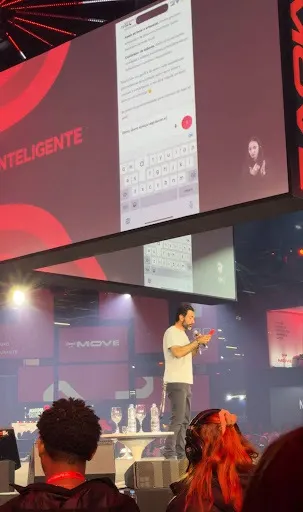
Weeks later, at the largest restaurant event in Latin America, we had our chance for redemption. Our CEO, rejecting any script, tested the assistant live with unrehearsed questions:
- “What do you know about me?”
- “Recommend me something for now”
- “Do you have napkins?”
The answer about napkins surprised us: “Usually restaurants that deliver through iFood already include napkins with the order, but this can vary depending on the establishment.”
We had never trained specifically for this. It was validation that we were creating something genuinely intelligent, not just a system of programmed responses. Disruptive innovation had found its initial product-market fit.
From Zero to First Users: The Importance of Early Adopters
Geoffrey Moore, in “Crossing the Chasm”, teaches us about the importance of early adopters. We went from zero to a 40% increase in the new experience vs the app’s standard search, religiously following the principle of co-creation with real users.
How do we ensure the product is right? That it makes sense? That the answers that can vary individually are relevant?
It was with these doubts that we returned to the basics of product building: always being in contact with the user.
We created WhatsApp groups with close friends, people from the iFood community (if you want to participate in groups like this, come be part of our community sign up here). This group helped us map experience problems, evaluate recommendations, find bugs.
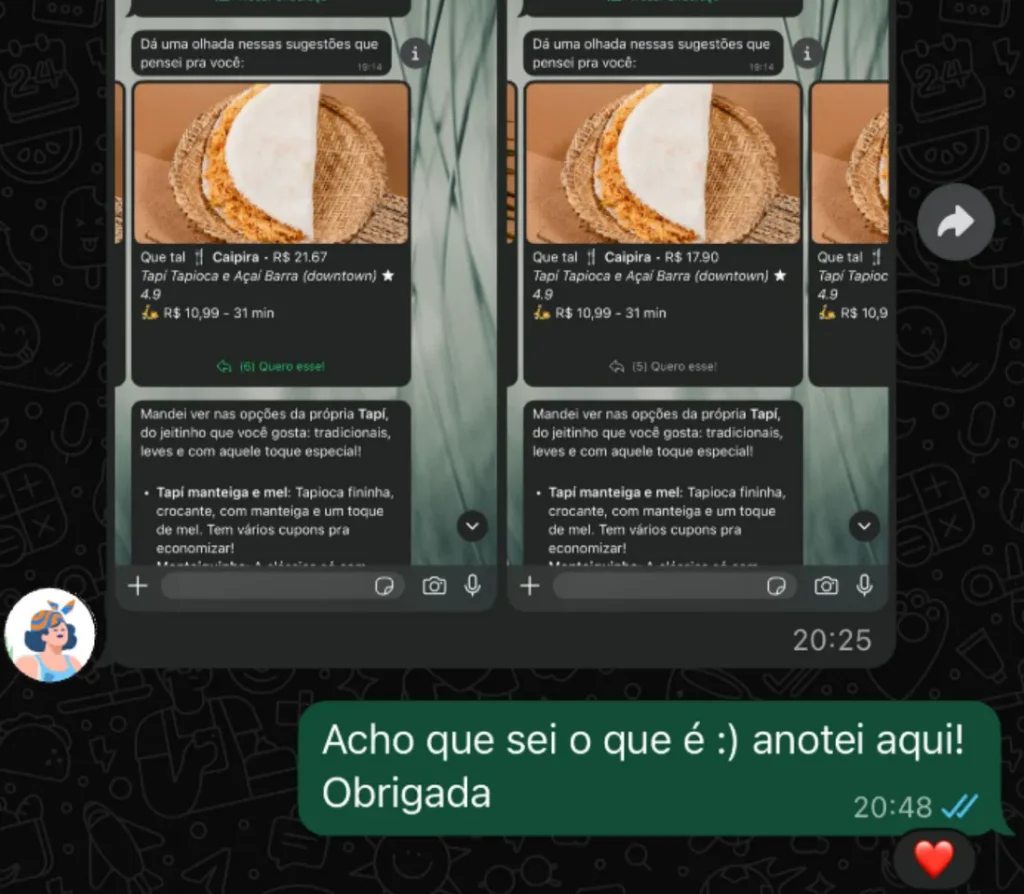
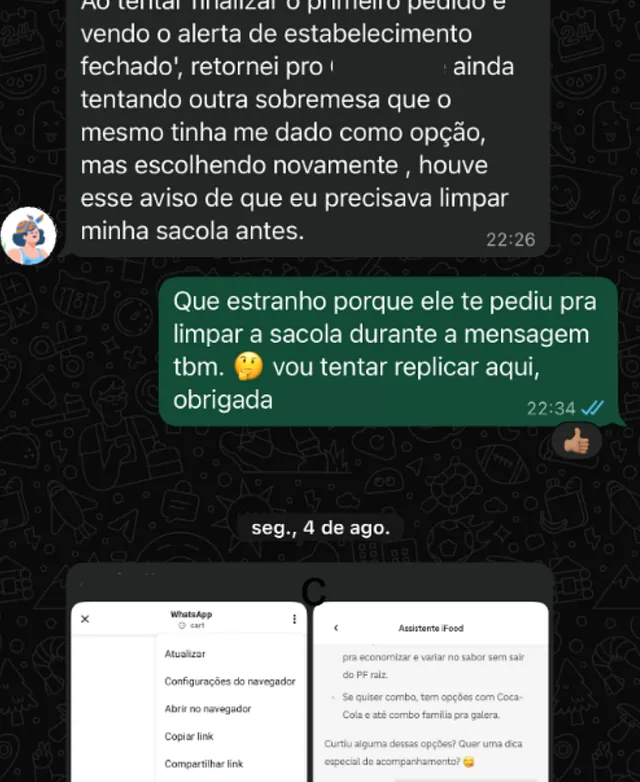
The crucial learning? We should have done this from day zero, even without a product. When we finally implemented it, the insights collected reformulated 100% of our product architecture.
As Ries emphasizes: “If you are not embarrassed by the first version of your product, you launched too late.”
What we learned so far:
1. Context is King
It’s not enough to recommend, you need to understand the moment, the time, the mood, the story. A hamburger at 5 AM could be dinner for someone who worked all night or breakfast for someone who just came from a party 🙂
As Erika Hall and Cathy Pearl, two of the main references in conversational design, already argue, designing agents is not just “writing responses”: it’s thinking about tone, context, failure recovery and realistic expectations.
2. Iteration Speed as Competitive Advantage
Every error becomes an adjustment in hours, not weeks. This is our disruptive advantage, while large corporations take months to approve changes, we iterate daily.
3. Trust Through Transparency
Users need to feel that the assistant is a reliable ally, not a mysterious black box. Transparency generates trust, trust generates adoption. And more importantly, that the decision power as well as their final autonomy, is not replaced by the agent without their permission.
4. Technology is Only 50% of the Equation
The other half is human experience: simple, natural, available. As Jobs said, “technology alone is not enough — it’s technology married with humanity, that brings us results that make our emotions connect with the product.
The AI Paradox: Never Ready, Always Evolving
Here’s our biggest epiphany, aligned with Lean Startup principles: there’s no “ready” AI product. There’s a constantly evolving relationship with those who use it.
Every conversation is data, every interaction is learning, every day the product is different from yesterday. It’s the ultimate continuous deployment — not just code, but intelligence.
The Future is Collaborative
Clayton Christensen taught us that disruptive innovations start by serving neglected markets or creating entirely new markets. Our assistant doesn’t compete with iFood’s traditional app — it creates a new category of interaction, a new way of thinking about ordering food.
And this product, where is it?
The product is constantly evolving, but you can start testing the version on our WhatsApp now, click here and test now!
And following our culture of collaboration and testing, send us here in this form if you find any problems, improvement suggestions, or something you liked about the experience.
The Journey Continues
As Eric Ries reminds us: “Success is not delivering a feature; success is learning how to solve the customer’s problem.”
We’re just at the beginning. Each pivot brought us closer to users’ true needs. Each public error made us more resilient. Each feedback made us more resilient in our purpose.
True disruption is not in the technology itself, but in how it naturally intertwines with people’s daily lives, making the complex simple, the time-consuming instant, the expensive accessible.
And you, what would you like to see in the next chapters of this journey?
“The biggest risk is not taking any risk.”
Peter Thiel
And in our case: “The biggest risk is not listening to those who use it.”
Text written in partnership with
Isabella Piratininga, Director of Technology and Innovation, and
Valéria Romano, Senior Manager of Product & Design.
Build the future at iFood
We are always looking for passionate developers, designers and data scientists to help us revolutionize the food delivery experience. Join iFood Tech and be part of building the future of food technology.
Discover our Careers
You might also like to read
Read more about Product & Design
The iFood Way of Building Products: how we structure problems before scaling solutions
A manifesto on how we create products that evolve fast and transform the world. Extraordinary products are not born ready. They evolve with each decision. At iFood, building products means dealing with a living ecosystem, where technology, operations, and business…

iFood Camp: how AI, behavior and Brazilianness are reshaping the way we build products
With leaders from iFood, OLX and Grupo Boticário, the event discussed AI, hyperpersonalization and the challenges of building technology in the Brazilian context Artificial intelligence, behavior and cultural context were at the center of discussions at the first edition of…

Ailo: from experiment to product with purpose
Over the past few months, Ailo, our AI agent for consumers, has evolved from a small experiment into a product with purpose. If you missed our previous posts where we shared the creation process of this AI agent, we recommend…

Meet other Authors
Each article is the result of the vision and expertise of our authors. See who contributes to our blog: