
Tech Meal Onboarding and Elas São Tech: The Evolution of the Experience for Those Who Came to Work in Engineering at iFood
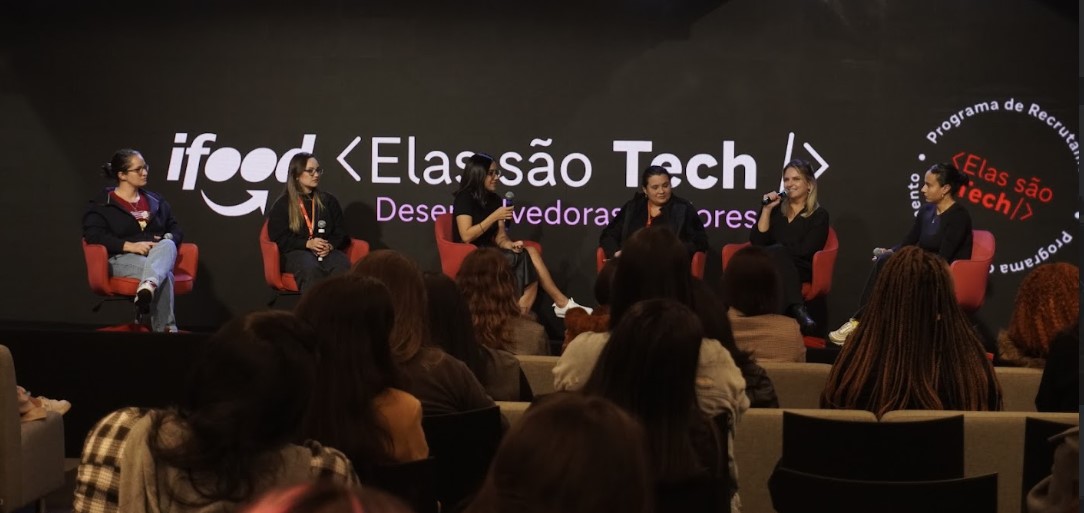
This article details the development and impact of the Tech Meal Bootcamp – together with the Elas São Tech program, a 3-month diversity initiative that trained 50 junior women in back-end development with a focus on delivering code to production throughout a structured development journey.
The importance of structured onboarding focused on ramp up
Starting a new job is always a challenge: adapting to the culture, understanding company-specific terms, familiarizing yourself with various existing tools, getting to know the new team, and understanding the scope of work. And when we talk about tech, this challenge gains some extra layers, for example, repositories to explore, architectures to understand, processes to absorb.
For these reasons, we developed a structured tech onboarding model as part of the development journey for the Elas São Tech program, aimed at hiring 50 junior software engineers working with back-end development. It was 3 months of knowledge dissemination, practical application, and socio-emotional training for the participants.
The premise defined by the responsible team was clear when structuring the program’s onboarding: reduce learning curve time without sacrificing technical depth and have artificial intelligence in all stages. In addition to providing an unparalleled experience regarding possibilities at the beginning of working at iFood, following one of the pillars of iFood Culture: dream big.
Structuring based on modules – the Code Labs
The Tech Meal Bootcamp was designed as a modular project, which could be replicated in different contexts, seniority levels, and audiences. And the beginning of the project already had a very specific action: the Code Labs. It was seven days of immersion in a series of main subjects that permeate the software development process at iFood:
- Welcome and general access;
- Engineering Principles, documentation and repositories;
- Platform Engineering and Artificial Intelligence;
- Hello World of an application (going through Pipelines, Quality Gates, Kubernetes, Deploy Jobs and much more);
- Main tools and concepts of Security and Observability.
The results were very exciting regarding the experience of the participants: metrics focused on satisfaction obtained an average of 96.5% approval. The main positive points presented by the participants: the journey was essential for familiarization with iFood tools, in addition to the immersive week being crucial to reduce the initial learning curve. Some adjustments established for the continuation of the project were, for example, the content load “squeezed” at the beginning; in addition to complex tools being taught without an immediate real use case.
Prior assessment
Upon completing the Code Labs, the program participants began the Bootcamp journey. They were divided into 10 groups of 5 people according to skills and assessments previously conducted on a series of hard skills related to software development – such as computer science and programming fundamentals, architecture and systems design, data and artificial intelligence, quality, platforms, cloud and security. During the Bootcamp, they had 12 weeks to develop practical challenges connected with AI integration, so they could evolve in skills.
These were evaluations where we could identify exactly which subjects we should deepen – in addition to contributing to knowledge ramp up. Below, in the chart, it is possible to identify the evolution of participants in the topics:
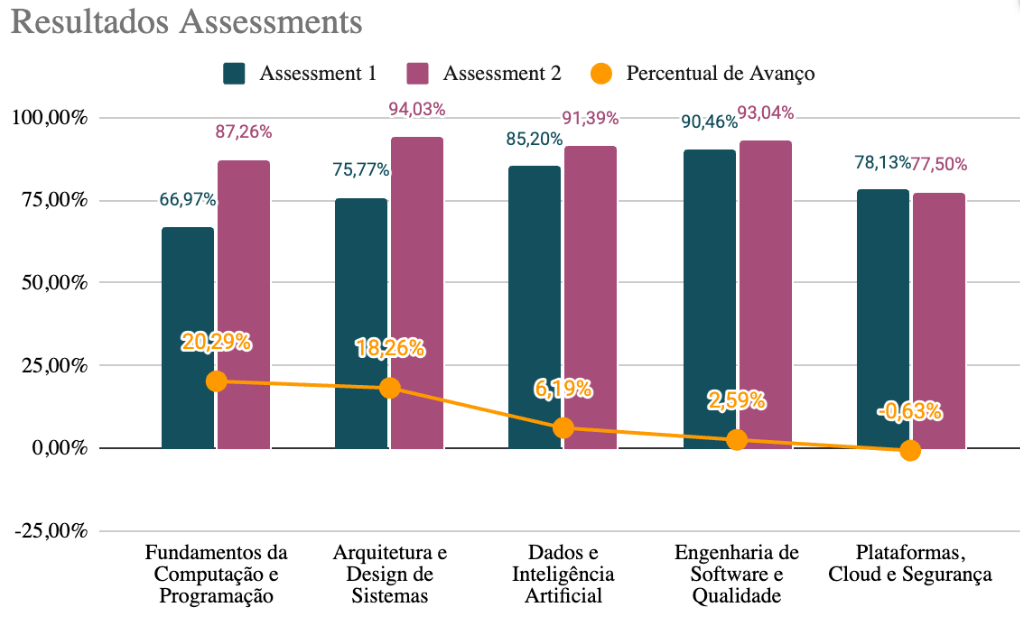
The evolution index shows us that 76% of participants (35/49) showed technical growth, with an average evolution increment of 9.3 points in overall performance. The highlight was that the biggest learning leap occurred in Computer Science and Programming Fundamentals.
Platforms, Cloud and Security: We identified a drop of less than 1% in this technical knowledge, one of the learnings we had was to bring as a focus in onboarding and mentoring, knowledge related to Infrastructure, as we identified that it can be an important development point for the junior audience.
Mentoring and Meetups as a strategy to multiply knowledge
The program also had a series of mentors who contributed to the evolution of the participants. The sessions were focused on solving problems or specific technical doubts – divided by expert mentors in each of the main areas that had relation: product, data, back-end, front-end, AI and infrastructure.
The meetings were essential for technical impediments to be resolved with greater agility, in addition to adequate and close support to the participants, especially with experienced people.
The meetups were developed with the purpose of bringing knowledge with external and internal speakers, focusing on real cases. The themes explored were:
- Meetup 1: “Communication that connects” – focused on improving communication skills, writing ability and non-violent communication;
- Meetup 2: “Agile Collaboration in practice” – presentation of Agile methods, project organization and relationship with peers and teams;
- Meetup 3: “How to solve problems?” – meeting that provided information on how to manage conflicts;
- Meetup 4: “Organization and Time Management for Results.” – meeting to discuss how to optimize and about performance when managing a complex project.
In addition to the SoftSkills MeetUps, we identified the need to improve knowledge related to GenAI, so we also included 2 one-hour meetings focused on the topic.
The results of the meetings had 92.6% approval from participants and the main positive points and improvements:
- High quality and relevant topics (especially AI and Distributed Systems);
- Well-prepared instructors and dynamic sessions;
- Practical cases and hands-on exercises;
- The timing and some content were delivered at the end, competing with the final project delivery time.
Socio-emotional track and empowerment in soft skills
The Socio-emotional Track was developed to provide learning related to self-knowledge, with the purpose of promoting a safe space during the journey, where they could question and exchange. It was essential for mental balance during the bootcamp journey, development beyond the technical and also present how to enhance their soft skills.
Impact metrics focused on code delivery
The main metrics defined for measuring the program were focused on Code Delivery – indicators that measure quantitatively with focus on speed and quality throughout the software development process. During the 3 months of bootcamp, significant improvements were observed throughout the program, such as:
- A 72% reduction in Coding Time over 12 weeks, an 11x acceleration in Deploy Time (from ~40 days to ~3.5 days) over 6 weeks;
- 95% improvements in Review Time (from ~3 days to ~3.5 hours) and 99% in Pick Up Time (from ~3 days to ~1 hour);
- The program generated more than 700 merge requests (MRs), with an average of more than 14 MRs per participant.
These indicators, combined with high satisfaction rates (96.5% in Code Labs and 92.6% in Meetups), validate the model and reinforce iFood’s commitment not only to diversity, but to technical excellence and the development of talents who deliver value in production quickly. The Elas São Tech program is a success case that elevates the onboarding experience and enhances the iFood Culture Pillar: Dream Big.
Larissa Vitoriano
Developer Relations
Larissa works as a Developer Relations at iFood. She is from São Paulo, loves to travel, and enjoys going for walks with her dog Frida Maria.
Build the future at iFood
We are always looking for passionate developers, designers and data scientists to help us revolutionize the food delivery experience. Join iFood Tech and be part of building the future of food technology.
Discover our Careers
You might also like to read
Read more about Culture and Careers

Meet other Authors
Each article is the result of the vision and expertise of our authors. See who contributes to our blog: